Rest

Rest

This is post number eleven On the Writing Life:12 Simple Habits for a Writing Life that Lasts, by Ann Kroeker and Charity Singleton Craig, hosted by Kate Motaung.

One of the discussion questions for this chapter is, “Do you have trouble with rest?” I have perhaps misquoted this slightly in my perennial flurry. I would go back and double-check to ensure that I have the quote verbatim, but I am deliberately leaving it as is since I think it speaks to my underlying difficulty with the concept of rest. If this is not the precise wording of the question, this is the question that I need to find the answer for.

Yes, I have a problem with rest.

I am not referring to my insomnia. I have trouble taking restorative rest because I become sick and am unable to work so often. The truth is supposed to release you, but it looks ugly to me. All my life I have battled chronic illness, so I am always playing catch up. In theory I take breaks. I take plenty of breaks. Being too weak to hold your head up or in extreme pain is not restful, however. As I studied this chapter and read the other posts I was convicted in the strongest possible way. I rarely have time for restorative rest. Honestly, I don’t imagine that any significant change can be made to this scenario. The demands of family alone leave me depleted. I imagine that many moms of young children experience the same challenges no matter how robust their health. Doubtless many others find the same difficulties for a variety of reasons.

  • What comes between you and restorative breaks?
  • What techniques do you employ to keep your creative energy flowing?

What I can change is my attitude and my planning. I had not thought of allowing restorative respite of non-verbal periods in the writing schedule. This I shall attempt in the future. Even brief stops may be useful, and brief stops I can allow myself.
image

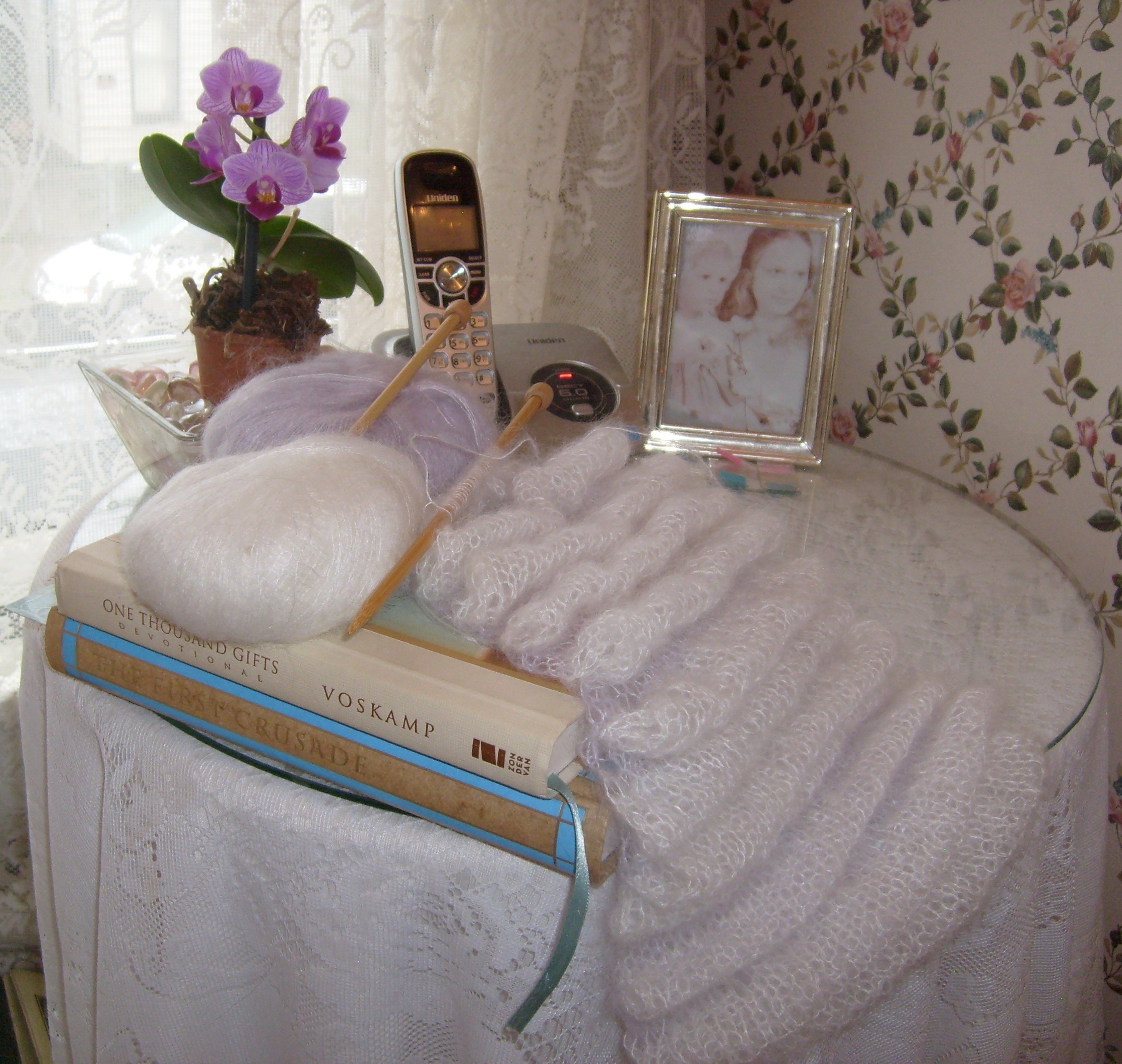
I love to knit. I find it very relaxing and I can knit when I am too sick to do anything else. Unless I am knitting a complex pattern I find plenty of parts in knitting that I can do while lying down, with my eyes closed. I frequently reserve it for when I am unable to accomplish something more productive. Knitting sometimes contains parts where I do need to check a pattern periodically. My knitting basket happens to hang just beside the chaise where I do my writing. Inspiration is leading me to think that 15 minutes of knitting scheduled every 2 hours of writing might be a good idea. Tiny knitting breaks might give my brain useful reflect periods.

  • Does this sound silly?
  • Would it be wasteful to use precious fully functioning writing time on something as frivolous as knitting?
Planning

Planning

image


I have a complex relationship with planning. I have always been a list maker who loves her planners and creates outlines in copious detail. I confess to being one of those who will add something to the list and check it off if I accomplish something that I did not have on the list to begin with. The sense of self-worth that comes with the check mark warrants the extra seconds it takes to add the new activity. I always plan. It seems hard-wired into my personality. My sister and I are regularly at odds over the topic because she is positivity list-averse. I was really lucky today. When I handed her a copy of the grocery list she put it in her purse. She never looked at it, but she accepted the proffered paper and she has refused in the past.

The complication in the planning exists in the fact that life often refuses to cooperate with my plans. If I have an important event planed I have backup plans for my backup plans. No matter how much I plan, something will always occur that I had not expected. This past week has been a case in point. A series of health problems occurred that have left a string of cancelled appointments and missed due dates. This post was supposed to be on Wednesday but it is now Sunday night. I have lived my life buffeted by endless health problems by always believing that tomorrow will be a good day. Today may be miserable but tomorrow holds the promise of greater strength. Sometimes my hope is fulfilled, sometimes it is not.

I often think that planning is just another way we humans seek to be in control. I have a valid reason for writing everything down. I often become very faint, have blurry vision and short-term memory difficulty. After I lie down long enough to get the blood back in my brain I remember everything. However, sometimes I need to be reminded of something while I am “hazy.” The help of written notes and computer generated alert tone reminders is tremendous.  In all candor, that is not the only reason I make so many plans. I also plan to have a sense of what to expect. I plan for today, tomorrow, next week, next year hoping to achieve a certain outcome.  It would also be true to say that no matter how successful the event I plan turns out I am never fully satisfied. Nothing is ever entirely what I had envisioned.

I have trouble getting everything on my To Do list done. I found that I average seventeen tasks every day on my list. Some days I expect still more. No, I do not list things like feed the dog or make my bed, the list is based on the assumption I will do the basics. There may be some wunderkind who can accomplish seventeen tasks on average every day.  I envy them. I have recently come to the realization that I may be expecting too much from myself.

I have decided to rename the list the Opportunities list as opposed to the To Do list.

Since I have plenty of vision and ample imagination it truly is a list of opportunities for what I may be able to accomplish. I may not be able to fully realize all of these goals in one day, but they are recorded so that I may accomplish them sooner as opposed to later. I will likely add new opportunities to the list in an hour. That is just fine. I will always see room for improvement and keep trying to perfect myself. Caught inside my own human limitations I aim for that which cannot be had. There is no need to despair. Tomorrow will be a better day!

I am not in control. Ultimately, God is the only one who knows exactly what tomorrow holds. I find comfort in this thought. He who holds the future in His hand, loves us unconditionally. I release my need to be all that I dream. I allow God to be in charge. Everything actually will work out according to His divine plan in the end. That does not mean that I will stop planning. On the contrary, my lists and agendas are one of the ways that I make my best effort to live my life fully for God. Migraines may come, but I know that the agenda will help me to do everything possible given the resources I have to work with that day. Things probably won’t turn out exactly as I expected every times, but sometimes they may exceed my expectations. There are times when things appear very bleak. That does not lead to despair. God sends His children on course-corrections. These are the very times I must let go of my fear over my loss, pause and like a wondering child ask with anticipation of my Abba*, “What’s next?”

This is the tenth installment On the Writing Life: 12 Simple Habits for a Writing Life that Lasts, Ann Kroeker and Charity Singleton Craig. The online discussion group is hosted by Kate Motaung. See what everyone else is saying by clicking here.
*”Abba” is the Aramaic name that Jesus used for God our Heavenly Father in the Lord’s Prayer. It is actually the name little children use for father, probably better translated into modern English as “Daddy.”

Engaging Discussions

Engaging Discussions

This post is number nine in a series On Being a Writer: 12 Simple Habits for a Writing Life that Lasts, by Ann Kroeker and Charity Singleton Craig, hosted by Kate Motaung.

In contemplating engaging with other writers and creative people I find myself very grateful for the internet. The ability to gather with like-minded people and grow as part of a group despite the span of miles is an enormous blessing. I considered the call to write long ago. I always wrote, but I should specify that I considered a career just out of college. I did not stumble upon a group of Christian writers at that time. In the secular sphere I felt like I did not belong. In truth, I felt as though I was too anachronistic to ever belong. I went to work in the church. I believed that it was the only place where my contribution would be welcome.

After more than a decade I did stumble upon a Christian writer’s community online. In many and various ways I found parts of myself. I had suffered under the illusion that I was an anomaly. I learned that there are many other people who view the world in many of the ways that I do. I am learning that one of the enemy ‘s chief tools is to isolate us and suffer us to keep quiet about our faith out of fear that very few people share our faith today. The Internet has torn down walls that kept us quiet. We are a community of believers. We are strong enough to build each other up. The internet is famous for those who tear other people down. Social media has a bad reputation. In my view it is undeserved.

Since the early church believers have encouraged one another. We have always been a community that resembles a family. There are always relatives who behave selfishly, however, Christians are not as a rule dysfunctional. The most positive and caring group you can affiliate with are Christians with mature faith. If you have been hurt by believers keep looking, for there are many good groups. Do not become discouraged. I wish that I had known about groups like (in)Courage and Five Minute Friday’s sooner.

image

I have enjoyed being a part of this writing group! I will be linking up with 31 Days in October as well. If all goes as planned I will be checking out a local real-life writer’s group tomorrow. They are not a Christian group per se, but hopefully I will find some encouragement there as well. I have the courage to try because of the online communities that I have been able to become a part of. It is possible that someone may want to read my thoughts. Thanks to the online Christians I am certain that God did not give me a love of words to frustrate me. There is a purpose to my penchant for obtuse words and if one person is uplifted by my verbosity then it is all for the glory of Jesus Christ. I think that this is the key difference in between Christian writers and the secular writers. We are not looking for our own glory. My image is irrelevant. I write to build up the reputation of Christ. If I look a bit foolish, or even very silly it is for a greater purpose.

1 Corinthians 1:18-25

Christ the Power and Wisdom of God

For the message about the cross is foolishness to those who are perishing, but to us who are being saved it is the power of God.

For it is written,
“I will destroy the wisdom of the wise,
and the discernment of the discerning I will thwart.”

Where is the one who is wise? Where is the scribe? Where is the debater of this age? Has not God made foolish the wisdom of the world? For since, in the wisdom of God, the world did not know God through wisdom, God decided, through the foolishness of our proclamation, to save those who believe. For Jews demand signs and Greeks desire wisdom, but we proclaim Christ crucified, a stumbling block to Jews and foolishness to Gentiles, but to those who are the called, both Jews and Greeks, Christ the power of God and the wisdom of God. For God’s foolishness is wiser than human wisdom, and God’s weakness is stronger than human strength.

1 Corinthians 4:10

We are fools for the sake of Christ, but you are wise in Christ. We are weak, but you are strong. You are held in honor, but we in disrepute.

Finding Myself

Finding Myself

This is a post On Being a Writer: 12 Simple Habits for a Writing Life that Lasts ,by Ann Kroeker and Charity Singleton Craig; Online Discussion Group sponsored by Kate Motaung, Session 8.
Who will I find in the words? When I read the Word, the Bible, I discover God. I learn who and what love actually is about and why we are all here on this blue ball caught in the sun’s orbit. We are here to learn to live in the Son’s orbit by learning how to love. Just like babies learning to speak and walk we copy the one we love.

I am at the point in life where I look in the mirror and find my mother looking back. When did I start to look so much like her? People tell me my actions remind them of her. I am flattered when that happens. She was my role model growing up.

Who am I imitating? Who do I copy at this stage? Keeping Jesus at the center of my life, my thoughts, my plans, my hopes should lead me further into His orbit. I want to learn true love. Agape love is an action not a feeling. Real love is a choice to put others ahead of myself. It does not depend upon how I feel.

How do I find myself in writing? The truth is, I learn more about myself in my study of Christ. As I process His perfect example of what being a human is all about I see myself more clearly than ever before. St. Paul directed the Corinthians in his first extant letter that now “we know only in part”. We “see in a mirror dimly” (1 Corinthians 13:12). As I study the Word I catch glimpses of what the world is supposed to be. I see what I am called to become. I need less of myself and more of Jesus. John the Baptist told his disciples of Jesus, “He must increase, but I must decrease.” John 3:30. The more I learn to outgrow my self-absorption the more I can grow into who I am meant to be.

It is astounding that the more I learn about how things ought to be the more I learn about who I really am. I grew up unconsciously learning to copy the world. I was never good at conformity. Friends were conversing about followers and leaders. I admitted that somehow I instinctively end up “out of step” with my peers. My mother always quoted Thoreau to me and told me I was, “Marching to the beat of [my] own drummer.” Eventually, I gave up worrying about others loosing step with me. I just try to follow Jesus and keep moving. The wonderful thing I discovered is that there are many others marching along to the same rhythm. The better I learn to keep in step with the Lord, the more I discover that this is who I am supposed to be.

image

image

To see more clearly and recognize the upside-down world for what it really is, I keep reading the Bible, contemplating the Word and for me that means writing about the Word. I process through the method of writing. Isaiah prophesied that the “…Word …shall not return to Me empty, but it shall accomplish that which I purpose.” (Isaiah 55:11). At times the world appears to be a hopeless mess. Staying in the Bible reminds me that love is stronger than hate and good ultimately triumphs over evil. Self-sacrificing love is the road to true success and self-preservation leads to suffering. The meek are actually the strong and the world will be made new. In loosing myself I most truly find myself and in Christ everything broken will be made whole.

S.D.G.

S.D.G.

Promoting my own material runs completely counter to my natural inclination and seems to fly in the face of Christians sensibilities. This is one area that I wish I could forget about.

Nevertheless, I occurs to me that there ought to be a difference between me and my work. As a Christian I believe that I am saved by the grace of God through the sacrifice of Jesus Christ. This is true despite the fact that everything I do is not good. Even when I do accomplish a good work it is not by my wisdom, strength or power but by the grace of God. I am capable of no good thing apart from Christ. So, if any bit of my work is good it is because of the blessing of God. It did not come from me. The glory does not belong to me. My work, be it good or bad, is not my possession, like a lamp, but a living thing, like a dog. I can train it. I can send it in a particular direction. I will receive the blame if it digs or defaces my neighbor’s property. But if it should chance to save someone it will not be me that everyone will talk about. Rather, it will be that something so unexpected managed to do a great good.

Pointer
Pointer

Once the words are sent out into the world. They have a life of their own. If I modestly promote the words it is not myself that I draw attention to. The words are about what God has done. They are words that He has given. They are tools to share His love. I love the way Johann Sebastian Bach dedicated his music. He wrote, “Soli Deo Gloria/S.D.G.” or “To the glory of God alone.” I can invite others to come and see what God has done. Stop and reflect on His amazing grace. See His hand print in beauty everywhere. Marvel with me at His incredible love. Share with me the wonder and awe at God, our Creator, Redeemer and the Giver of all good gifts!
This post is part of a series On Being a Writer, by Ann Kroeker and Charity Singleton Craig, hosted by Kate Motaung.

Rejection

Rejection

When I was growing up I was not one of the “cool” kids. Writers usually are not the social butterflies who instinctively enter the center of the group. We are generally just on the outside of the group observing and considering. Our reflective nature is suited to the outskirts. This makes us more sensitive to rejection. Unfortunately, rejection is a key component of writing.

We are required to submit pieces of our souls to publishers in hopes that they may be accepted. It is ruthlessly impersonal and yet to the writer it is the most personal experience. This is what makes it so hard for many of us to hit the send button. For the person on the other end it is simply a business decision based on recent publishing and market demand. Knowing that it is not a rejection of one’s self does not make it much easier. It takes enormous courage to share your writing at all. Submitting it for publication is brutal. The greatest success is to keep showing up and to keep sending. The history of publication is filled with bestseller a that were rejected time after time. We keep repeating to ourselves that rejection is not a reflection of our skill. Keeping the faith is an act of heroic stubbornness.

Endless little roadblocks seem to litter the paths of the writer. Even in blogging the travails never cease. I am entering the third week of repeated loss of my home internet access. The simple or the great difficulties can stop us if we believe it is about ourselves. I would give up and try something more accessible if I believed it was about my words reaching an audience. The reason I am committed this time is that I have come to believe that it is not my words that matter. This is about allowing God to use my words to do His will.

Onward I press because I carry a gift in this humble jar of clay. I have met the “light” and I am obligated to shine His light to the best of my ability. My cracks are tools that He can use to get more light out. Fortunately He is an expert in working miracles. So, I’m a day late, submitting this for your approval, dear reader, I am sitting in a hospital waiting room, so I can use the wifi while my sister does physical therapy. I have no idea why this is so complicated, but the One I love must have a plan. So many little things in life can interfere with our desire to tell others about God and His incredible love for mankind. Things are just a bit upside-down right now, including the pic on the link-up. I guess more cracks in the pot lets more light out. God bless you and your day.

This post is part of a series on Kate Motaung’s site for the Writer’s Discussion Group focusing on the book On Being a Writer: 12 Simple Habits for a Writing Life that Lasts, by Ann Kroeker and Charity Singleton Craig.

Just Write

Just Write

My favorite "weeds" Queen Anne's Lace.
My favorite “weeds” Queen Anne’s Lace.

Writing sounds simple enough, until you try it. In my experience writing is like a weed. When I gardened I read gardening books voraciously. I read many descriptions of weeds. My favorite explanation of weeds was by Celia Thaxter who proclaimed a weed, “A plant with a propensity to get itself into the wrong place.” Writing has an overwhelming tendency to show up at the wrong time and the wrong place.

Celia Thaxter in her Island garden painted by her friend Childe Hassam

This post is number five On Being a Writer from the Online Discussion Group hosted by Kate Motaung.


If I schedule writing time the odds of the words, just pouring out of my brain are not high. I will probably need something to “prime the pump” and get the words flowing. If I am on my way out the door and I will be busy for hours, the words gush out of my mind. Writing seems like a jealous lover, always testing to see if you love him enough to put him first. Despite all the bad analogies, writing can also be cathartic. Learning to live with the free-flow of words and ideas may be challenging, but ultimately worth the effort to negotiate a mutually beneficial treaty of wellbeing.

As so many people have said before, the words seem to come from someplace “other” than the writer’s brain. Writers are not entirely in charge. Prayer is my best help. In everything praying helps, but with writing it helps me to remember that the right words are never going to come from my own ability. Surrender is the difficult route to the most successful writing. Writing can be about letting the words come unbidden. Poetry always comes to me without conscious effort. I only know I have a poem when I have a couple of stanzas in my thoughts. The meter and/or rhyme attracts my attention and I scurry to find a pen before they are gone.

When I make time and allow the words room in my life I am happier and more fulfilled. On a deep level, beyond the words, I know that I am supposed to write. In the end, all I can do is repeat what King David said,” Let the words of my mouth[and keyboard] and the meditation of my heart be acceptable to you, O Lord, my rock and my redeemer.” Psalm 19:14. Amen.

Prayer
Prayer


Noticing the Beauty

Noticing the Beauty

This is post number four in the Online Writer’s Group hosted by Kate Motaung. Noticing and attending to what is going on around me comes naturally. I have a good friend who is the quintessential “absent-minded professor” who will notice a business that has been there for several years and she will “see it” for the first time. I get used to hearing, “When did they build that place?” She can successfully focus on what she is passionate about no matter how noisy the environment, or commotion. I wish I could be more like her. Every change, sound, visual stimulation, etc. catches my attention. I notice everything. As a child I became aware that not everyone hears the poetry in whispering leaves of the trees. In some ways society taught me to keep quiet about such noticing.

One of the marvelous attributes of the internet is that mine is not a singular experience. Those of us who are very attune to “noticing the art in the simple” find fellowship with one another in places like this.

The difficulty lies in honing in on the useful observations and recalling the correct detail over time. Organization is probably the key. Memory is fickle. I don’t have the option of what detail I remember from the distant past. I remember unusual details clearly for no apparent reason. My sister sang in a recital when I was two years old. I specially remember the turquoise smocked dress I wore. I remember getting dressed up on a weeknight evening. We drove to get my grandmother before the family drove to the a forgotten location. I remember that we were running late and my mother was stressed. I have no idea what my sister sang or how it sounded. I remember sitting on my mother’s lap and playing with her necklace. I was pleased that other people liked listening to my sister sing. The room had plush red carpet. All I have are disconnected peculiar details. Why do I remember what I wore? Was the fact that I had to put on my good dress on an ordinary evening the detail that was important to me? What is with the carpet? Was that memory indelibly etched in my memory because my home had oak floors?

I do not have a good catalogue of the rich sensory details that I have noticed over the course of my life. Much of it is disjointed, like my memory of the recital. Still more of my noticing has been recorded in my journals. These are slow to search through, although they are a treasure trove for finding what I really thought, felt and cared about at a particular stage. The barrage of details are carelessly stored in my brain in such a way as to make them only useful for fiction.

I would love to hear of useful ways to collate the glorious array of threads that weave the tapestry of the human life. What tools do you use to keep track of the details that you notice? I enjoyed learning in the video that Google drive documents are searchable by keyword. Does anyone have a favorite app? How do you keep account of all the little details that make life rich?

Memories
Memories
Surrounded in Beauty

Surrounded in Beauty

This post is part of Kate Motaung’s Writer’s Group session 3. Beauty surrounds each of us daily. I cultivate peace, or quiet with silence or uplifting music. I enjoy a pale blue ceiling so I always have blue skies, even on grey days. Great books, Bibles, legendary classics along with Christian writers of every century line the bookshelves that cradle my thought processes.

I absorb as much beauty as I can. For much too long a time I believed that only the “great” was worthy of creation. I have come to recognize that “good” is all we need to create. In Genesis 1 God called each part of creation good. Mankind God called very good. Every living thing was deemed good but the Creator. 

Failing to appreciate the good, by only seeking the great is tantamount to denying God’s creative spark. There are many parts of creation that I may not particularly enjoy. This fact doesn’t diminish the value of say, termites. I don’t want them in my house but they do serve a purpose. Finding joy in the simple doesn’t decrease the pleasure I find in the great.

Typically I write about faith intersecting with everyday life. I am surrounded with Bible verses and reading scripture and devotional literature. This makes my life and writing walk seamlessly together.

I have begun a novel set in Europe centuries ago. Living in twenty-first century America does seem a stretch. The mitigating factor is that I spent years in college studying this period and my fascination has not ceased. I am surrounded by books and other reference material connected to this era. When I write about this time I listen to music from the period. I do climb into a metaphorical time-machine. I transport myself back in time and space before I attempt to lead the reader there as well.

We do best as writers when we focus deeply on what we are attempting to share. Those who are passionate about something are best able to enchant others with the same joy. No one wants to consume our boredom. Everyone wants to drink deeply of the elixir of true joy.

Time and Space

Time and Space

This post is part of the online discussion group hosted by Kate Motaung On Being a Writer. Organizing space and schedule to facilitate writing is the subject of the day.  The book On Being a Writer:12 Simple Habits for a Writing Life that Lasts, by  Ann Kroeker and Charity Singleton Craig is the starting point for the discussion. Chapter two entitled,”Arrange” is the catalyst. 

  • There are two basic parts to this topic: space and schedule. I have space addressed. I now have a private study in which to write. I write while sitting in a chaise so that I can keep my feet elevated. I have my file box handy, a printer and a writing desk that I cannot really use. If I am able to work sitting with my feet on the floor again the desk will be useful. 
  • My space is adequate. The lighting is good. My problem is that I get bad migraines whenever I use my old pc-based laptop. I do all my writing on my iPad. Alas, it is now four years old and slowing me considerably. I will have to look into an upgrade in the future. This week I need to move my modem and router. Before I had my study I worked on a different floor and they were perfectly placed. My neighbor must have placed a router in the house next-door closer than my own router since their signal is now drowning out my signal. On Monday I had to write and post my piece entirely on my phone as I could not get a signal.  This week I am moving my equipment.
  • My greatest challenges to effective writing time are my health constraints and the fact that I spend a considerable amount of the time that I am able to be active driving my family and myself to a steady stream of doctors. The blessing of mobile devices is that they are portable and I can put waiting room time to good use. Scheduling all that I need to accomplish around P.O.T.S. limitations is constraining.
  • Since the difficulty increases the longer I have been up, morning is my most effective time. I start each day by 7 am, but I am going to try to consistently move that up to 6 am. The possible complication is being able to drive to and from afternoon appointments after I have been up that long. Perhaps I will need to start earlier still to ensure a rest before attempting afternoon appointments. 
  • I am committed to a minimum of 30 minutes of uninterrupted time per day. I have long scheduled writing for after dinner. It fits the schedule, but I am often foggy and unable to see clearly in the early evening. The schedule is a work-in-progress. What time of day do you write? Are you a morning or evening person? How do you get family to give you uninterrupted writing time? As long as I multitask my writing is respected and even admired, but as soon as I ask everyone to leave me alone, I am frequently accursed of being rude.